

Institutional Committees
The Academic Advisory Committee is constituted at the institute level to plan, monitor, and strengthen the overall academic framework. The committee acts as an advisory body to ensure quality education, effective implementation of curriculum, and continuous academic improvement in line with institutional goals and regulatory norms. It facilitates collaboration between departments, promotes innovative academic practices, and ensures the holistic development of students through academic excellence and skill enhancement initiatives.
Objective:
This committee is constituted at institute level, responsible for regulating and implementing different academic activities. It provides guidance & support in improving and implementation of curriculum at institute level. The committee supervises the teaching learning process on regular basis.
Functions of Academic Advisory Committee
- To advise for the improvement of the teaching-learning process by adopting best academic practices.
- To guide faculty members for their professional growth and career development.
- To improve the overall academic and administrative environment of the institution.
- To regulate and implement various academic activities at the institute level.
- To provide guidance and support for effective implementation of the curriculum.
- To supervise and monitor the teaching-learning process on a regular basis.
- To ensure continuous enhancement in academic quality and institutional performance.
Committee Members:
Under the Chairmanship of Director of the Institute, the Academic Advisory Committee of BBDITM has been constituted as per the norms of AICTE and guidelines prescribed by NBA, with following members under varying categories.
| Convener | Members |
| Dr. Usha Sharma |
|
| Frequency of Meeting | Once in a semester and as required |
Mechanism of the Committee:
The functioning of the Academic Advisory Committee follows a systematic mechanism to ensure transparency, accountability, and continuous improvement.
Flow of Mechanism:
- Constitution of Committee – The Head of Institute constitutes the committee with senior faculty members, HoDs, and external experts.
- Periodic Meetings – The committee meets periodically (once every semester or as required) to review academic progress and discuss key issues.
- Agenda Preparation – The Convener in consultation with the Chairman, prepares and circulates the agenda before each meeting.
- Review & Recommendations – The committee reviews departmental reports, teaching-learning outcomes, and student performance. Recommendations for improvement are recorded in the minutes.
- Implementation – Approved recommendations are communicated to concerned departments for action.
- Follow-up & Reporting – The progress of implementation is reviewed in subsequent meetings to ensure effective execution of decisions.
Role and Responsibilities:
- Monitoring the programs of internal reviews of learning and teaching.
- Offer guidance to the College on existing and proposed academic programs and research.
- Provide a connection to potential internships/training opportunities for students, employment opportunities for graduates, and to potential research and service opportunities for the faculty.
- Finalization of workload, lab distributions and framing of regular time tables.
- Review of academic activity, attendance, student feedback analysis with class teachers.
- Recommend ways to improve and develop the training and skills programs offered by the college.
- Monitoring the progress of teaching and learning as per the prescribed syllabus.
- Preparation of academic calendar.
- Identifying speakers and organizing guest lectures.
- Identification of course and framing of syllabi for certificate courses for skill development.
- Initiate innovative practices in teaching and learning.
Convener Contact Details-
 | Name: Dr. Usha Sharma Convener, Academic Advisory Committee, BBDITM Email: [email protected] |
About The Committee: The Grievance Redressal Committee(GRC) serves as the Institute’s formal mechanism for receiving, addressing, and resolving complaints from both students and employees (both faculty and staff). This cell aims to provide easy and readily accessible mechanism for speedy disposal of grievances in a fair and transparent manner without fear of retaliation, thereby protecting individual rights and strengthening institutional trust. The GRC includes one faculty member from each department to coordinate and address complaints arising within their department.It should be noted that any grievance alleging ragging will be forwarded to the Anti Ragging Squad/ Proctorial Board Committee, and any grievance alleging sexual harassment will be referred to the Internal Complaint Committee.
The Grievance Redressal Committee (GRC) is organised into two distinct cells:
- Student Grievance Redressal Cell — includes student members, this cell addresses complaints and concerns raised by the student community.
- Faculty/Staff Grievance Redressal Cell — Composed of faculty and staff members, this cell handles grievances originating from teaching and non-teaching employees.
I. Student Grievance Redressal Cell: A student complaint will be examined by the Grievance Redressal Cell which will take appropriate action thereafter. The Institute online complaint and suggestion box enables students to report any academic or non-academic issue.
The Student Grievance Redressal Cell is authorised to investigate matters of harassment.
- Any person with a genuine grievance may approach GRC members in person, lodge an online complaint or submit the grievance in writing if they prefer not to appear.
- Grievances may also be sent by email to the departmental GRC member, the Convenor of the Student Grievance Redressal Cell, or the Director.
- The Cell will advise students on treating one another with respect, decency, and tolerance when disagreements arise.
II. Faculty/Staff Grievance Redressal Cell: The Faculty/Staff Grievance Redressal Cell aims to address the following issues:
- The Faculty and Staff Grievance Redressal Cell addresses complaints raised by teaching and non-teaching employees and works to resolve workplace issues promptly and fairly.
- The Cell promotes a harmonious work environment by facilitating constructive Employee–Employee and Employer–Employee relationships.
- The Cell encourages faculty and staff to report grievances openly and without fear of victimization.
- The Cell advises employees to respect one another’s rights and dignity and to exercise restraint and patience when conflicts arise
Function of Committee:
I. Student Grievance Redressal Cell: The Cell addresses written grievances submitted by students concerning the following areas.
- Academic matters: Issues related to issuance of duplicate mark sheets, transfer certificates, conduct certificates, and other examination related concerns.
- Financial matters: Disputes involving dues, refunds, or charges for services such as library fines, hostel fees, and other college payments.
- Other matters: Complaints about campus facilities and services, including sanitation, transport, campus safety, and related infrastructure.
II. Faculty/Staff Grievance Redressal Cell: A Grievance Redressal Cell for faculty and staff has been constituted for the redressal of the problems reported by the faculties or staff members of the institute with the following objectives:
- To address the needs of faculty and staff and resolve grievances reported by teaching and non teaching employees.
- To uphold the institute’s dignity by fostering a strife free workplace and promoting cordial Employee–Employee and Employer–Employee relationships.
- To encourage faculty and staff to report grievances openly and without fear of victimization.
- To advise employees to respect one another’s rights and dignity and to exercise restraint and patience when conflicts arise.
Committee Members:
Under the Chairmanship of Director of the Institute, the Grievance Redressal Cell of BBDITM has been constituted as per the norms of AICTE and guidelines prescribed by NBA, with following members under varying categories.
| Convener | Members |
|
Dr. Supriya Phurailatpam | 1. Ms. VandanaAwasthi – Ombudsman 2. Dr. Anurag Tiwari – Chairman 3. Dr. SupriyaPhurailatpam – Convener 4. Mr. Rafik Ahmad, DSW & Proctor – Member – 9450026899 5. Dr. Abhimanyu Yadav – Member – 9913313348 6. Dr. Sangeeta Mishra – Member – 8840600929 7. Mr. Ravi – Member – 9958117477 8. Mr. Ashish Verma – Member – 8181053010 9. Mr. Fazlur Rahman – Member – 9839393255 10. Mr. VivekNarain – Member – 8004746392 11. Mr. Ankit Singh – Member – 8009473821 12. Dr. Pragya Singh (Psychologist-cum-Professional Counsellor) – Member 13. Mr. Tanuj Kumar (Lab Staff) – Member – 9452968718 Student Representative – 1. Mantasha, B.Tech (CSE) 3rd Year, 2300540100100 – Member 2. Prateek Rai, B.Tech (CSE) 3rd Year, 2300540100127 – Member 3. Anushika Chauhan, B.Tech (CSE-AIML) 3rd Year, 2300541530009- Member 4. Hasnain Abbas B.Tech (CSE-AIML) 3rd Year, 2300541530026 – Member 5. ApoorvaSahuB.Tech (CSE-DS) 3rd Year, 2300541540012 – Member 6. Tulika Srivastava B.Tech (IT) 3rd Year, 23005401300055 – Member 7. Vartika Singh B.Tech (ECE) 3rd Year, 2300540310056 – Member 8. MadhuPriyaB.Tech (ME) 3rd Year, 2300540400005 – Member
|
| Frequency of Meeting | Once a semester and as required. |
Mechanism of the Grievance Redressal Cell: The Cell performed the below mentioned functions continuously to make the best possible efforts to create a harmonious and conducive atmosphere for everyone in question:
- The Cell attends to cases promptly upon receipt of written/ online grievances.
- The Cell convenes regularly to review all cases and prepares statistical reports summarising cases received, resolved, and pending that may require higher level direction.
- The Cell examines each complaint to assess its merit and determine appropriate action.
- Strict confidentiality is maintained throughout the process when required.
I. Student Grievance Redressal Cell:
The following mechanism may be used to lodge and resolve grievance (s)
- Students may submit complaints online via the Institute grievance portal: https://bbdnitm.ac.in/grievances/ or drop a form in complaint boxes located at prominent campus points, or submit the grievance in writing to the concerned departmental GRC member.
- The composition and contact details of the Student Grievance Redressal Cell will be widely published across campus.
- The GRC advices students to submitnecessary documents to support their cases.
- The GRC will take up matters that remain unresolved by the respective departments; financial grievances (for example, fee disputes) must be supported by relevant financial documents such as receipts or demand drafts.
- The GRC will processes written grievances promptly, reviews and reports on cases regularly, investigates merit impartially, maintains confidentiality, and acts on submissions received through the online portal or official complaint boxes with required documents.
II. Faculty/Staff Grievance Redressal Cell
The following mechanism may be used to lodge and resolve grievance(s):
- Aggrieved faculty or staff may submit a written grievance by dropping it in the grievance boxes located various location at E Block& M-Block, BBDITM
- Grievances may also be submitted via the college grievance portal at https://bbdnitm.ac.in/grievances/.
- Faculty or staff may address a written complaint to the Departmental Coordinator or Convenor, Grievance Redressal Cell, BBDITM.
- The GRC will act upon those cases which have been forwarded along with the necessary documents.
- Each received grievance will be logged, verified for completeness, and acknowledged.
- The Grievance Cell will investigate and ensure the grievance is resolved within the time frame prescribed by the Committee.
- The Grievance Redressal Cell will monitor the status and progress of each grievance until closure.
- The Cell will furnish periodic reports on grievance disposition and outstanding cases to the Chairman of the Committee.
Role and responsibility of committee:
I. Student Grievance Redressal Cell:
Students GRC has following roles and responsibilities:
- To formulate policy for investigating and reviewing student complaints and grievances.
- To investigate the root causes of grievances.
- To ensure effective remedies or actions proportional to the seriousness of each case.
- To encourage students to report grievances openly and without fear of victimization.
II. Faculty/Staff Grievance Redressal Cell
The Faculty/ Staff GRC has the following roles and responsibilities:
- To formulate policies and procedures for receiving, investigating, and reviewing grievances of faculty and staff.
- To investigate the root causes of reported grievances and gather relevant facts.
- To recommend and ensure implementation of effective remedies or corrective actions proportional to the gravity of each case.
- To foster an environment where faculty and staff can express concerns freely and frankly without fear of retaliation.
- To promote mutual respect and professional conduct among employees and between employees and management.
Convener Contact:
 | Name of Convener: Dr. SupriyaPhurailatpam Convener, Grievance Redressal Cell, BBDITM Email: [email protected] Mob. No.:8318088682 |
The IQACof BBDITM has continuously endeavored to improve quality and support initiatives to enhance academic related activities. The committee, within its preview, aims to act as a quality assurance unit inside the institute, with the aim of developing methods for improving quality and eradicating flaws, directing the institute’s efforts toward achieving all-around academic success.
The functions of IQAC are listed below:
- To develop a system for conscious, consistent and catalytic action to improve the academic and administrative performance of the institution.
- To conduct quality checks on different activities undertaken in all departments/ sections/ student activity centers of the institution to meet expected outcomes and institutionalization of best practices.
Committee Members:
Under the Chairmanship of Director of the Institute, the Internal Quality Assurance Committee of BBDITM has been constituted as per the norms of AICTE and guidelines prescribed by NBA, with following members under varying categories.
| Convener | Members |
| Director, BBDITM Chairman
Dr. UshaShrarma Convener
Mr. Achman Mishra Member Secretary
| 1. Dr. S. H. Abdi 2. Mr. Shivanand 3. Mr. Ashish Verma 4. Mr. Navneet Pandey 5. Mr. KamleshwarDharDwivedi 6. Mr. Abhishek Dubey 7. Mr. Shahab Ahmad 8. Dr.Sangeeta Mishra 9. Ms. DeeptiRanjan 10. Mr. Ankit Singh 11. Mr. Prashant Malviy, Head, Delivery System,TCS, Lucknow (Alumni) 12. Dr. Dhyan Chandra Yadav, External Member, BBDU |
| Frequency of Meeting | Twice in a year |
IQAC Mechanism:
IQAC shall evolve a mechanism and procedure for:
- Ensuring timely, efficient and progressive performance of academic and administrative activities.
- Adoption of relevant and quality academic and research programmes.
- Optimization and integration of modern methods of teaching and learning.
- Ensuring the proper allocation, adequacy and maintenance of support structure and services.
Roles and Responsibilities:
The roles and responsibilities of the IQAC are to:
- Ensure heightened level of clarity and focus on institutional functioning towards quality enhancement.
- Assess the activities involved in developing learning outcomes, design and development activities in curriculum, teaching-learning process, student learning assessment process and student engagement programs.
- Assess the quality and quantity of research outcomes during last three years.
- Ensure the quality of resources and general ambiance from perspective of meeting the learning outcome.
- Promote adoption of best practices.
- Act as a dynamic system for quality changes in the colleges
- Build an organized methodology of documentation and internal communication.
Convener Contact Details-
| Name: Dr.Usha Sharma Convener, IQAC BBDITM Email : [email protected] Mob. : 9873939570 |
1. About The Committee:
Anti-Ragging Committee of BBDITM to ensure compliance with the provisions of Regulations as well as the provisions of any law for the time being in force concerning ragging; and also, to monitor and oversee the performance of the Anti-Ragging Squad in prevention of ragging in the institution. As per the order of Supreme Court of India and subsequent Notification from AICTE, Anti-Ragging Committee will take part in creating strategies and an action plan to reduce the threat of ragging at the college by implementing a variety of activities. Under Anti-Ragging Committee zero tolerance strict practices has been followed.
Objectives of the Anti‑Ragging Committee
- Anti-Ragging Committee responsible for inculcating Culture of Ragging Free Environment in the Campus as per guidelines provided by Government.
- Anti-Ragging Committee will be involved in designing strategies and action plan for curbing the Menace of Ragging in the college by adopting array of activities.
- The Proctorial board members are assigned the works of checking places like Hostels (Boys and Girls), Buses, Canteens, Classrooms and other places of student congregation.
2. Function of Committee:
The Anti-Ragging Committee is the apex body in the institution responsible for ensuring a safe, respectful, and ragging-free environment for students. Its core functions include:
- Policy Implementation & Oversight
- Enforces UGC/AICTE anti-ragging regulations and Supreme Court directives within the institution.
- Formulates and reviews anti-ragging policies, rules, and preventive measures at the college level.
- Prevention & Awareness
- Organizes orientation sessions, workshops, and awareness drives for both freshers and seniors.
- Disseminates anti-ragging information through posters, banners, handbooks, and circulars.
- Monitoring Campus Activities
- Collaborates with the Anti-Ragging Squad and Proctorial Board to conduct surprise checks in:
- Hostels
- Canteens
- Classrooms
- Buses
- Common areas
- Ensures that “zero tolerance to ragging” is actively enforced.
- Support to Students
- Provides mentoring and counseling support to freshers.
- Encourages students to report ragging via helplines, faculty, or online forms.
- Maintains confidentiality and sensitivity in handling complaints.
- Inquiry & Disciplinary Action
- Conducts investigations into reported cases of ragging.
- Recommends appropriate disciplinary action, which may include:
- Suspension
- Expulsion
- FIR filing (for criminal offences)
- Withholding of scholarships or degrees
- Coordination with Authorities
- Works in collaboration with:
- Local police (e.g., BBD Police Chowki)
- Media and parents
- University / affiliating body
- Reporting & Documentation
- Maintains detailed records of:
- Committee meetings
- Awareness activities
- Complaints and action taken reports (ATRs)
Submits compliance reports to AICTE/AKTU and other authorities as required.
3. Committee Members:
| Convener | Members |
|
Dr. Anurag Tiwari Asst. Director (BBDITM) |
|
| Frequency of Meeting | Four in a year |
4. Mechanism of committee:
The Anti-Ragging Committee functions through a structured mechanism involving prevention, monitoring, complaint handling, investigation, and disciplinary action.
- 1. Preventive Mechanism
- Orientation Programs: Freshers and senior students attend sessions about rules against ragging and consequences.
- Undertakings: Both students and parents sign anti-ragging affidavits at the time of admission.
- Posters & Publicity: Anti-ragging messages and helpline details are displayed across campus, hostels, buses, and online.
- Mentorship System: Faculty and senior students are assigned as mentors to freshers for guidance and support.
- Monitoring Mechanism
- Anti-Ragging Squad &Proctorial Team:
- Conducts surprise rounds in vulnerable areas like hostels, canteens, corridors, and buses.
- Reports suspicious activities to the committee.
- Vigilance: CCTV surveillance in strategic locations to monitor student behavior.
- Complaint Mechanism
- Students can report ragging through:
- Directly contacting faculty members, proctors, or hostel wardens
- Using dedicated helpline numbers
- Written complaints or online forms on the college website
- Anonymous reporting is also encouraged to protect victims.
- Inquiry & Investigation Mechanism
- Upon receiving a complaint:
- The committee immediately convenes and forms a fact-finding subcommittee.
- Statements from the complainant, accused, and witnesses are recorded confidentially.
- Evidence is reviewed, and a report is prepared.
- Action & Disciplinary Mechanism
- Based on the findings, the committee recommends action, which may include:
- Warning or Counselling
- Suspension from classes or hostel
- Expulsion or rustication
- Filing FIR if the case involves criminal offense (in coordination with police)
- Disciplinary decisions are communicated to all parties and recorded officially.
- Review & Reporting Mechanism
- Regular Meetings: Held at least twice per semester or as needed.
- Documentation: All incidents, actions taken, and outcomes are documented.
- Compliance Reporting: Reports are sent to regulatory bodies (AICTE/AKTU/UGC).
5. Role and responsibility of committee:
- The major postulate of the Committee is to maintain the overall discipline in the Institute campus including hostel, mess, canteen and student transport.
- To stop any behaviour that might be construed as taunting, treating, or handling another student in an unkind manner, whether it be by words, actions, or both, whether it be spoken, written, or both.
- To prevent any student from engaging in boisterous or unruly behaviour that annoys or is likely to annoy, burden, inflict bodily or psychological injury, or to inspire fear or concern in any freshmen or other student.
- To keep an eye out for any behaviour on the part of a senior student that inhibits, impedes, or otherwise upsets another students or a freshmens usual academic activities.
- To avoid any verbal or physical abuse, as well as public insults and other behaviour that may cause a fresher or another student to feel uncomfortable, whether it be by active or passive participation.
Mechanism: Following are the Mechanism of Anti-Ragging Committee:
- Spread awareness of Institute rules and regulations and maintain discipline in the campus.
- If any indiscipline occurs in the campus, student shall bring it to the notice of committee through proctor.
- A meeting shall be called to discuss the complaint.
- The views of each individual member shall be taken during the meeting.
- The recommendations of the members shall be sought regarding the issue.
- Anti-Ragging Squad will be working under the Monitoring of Proctorial Board and will seek advice from the Proctorial Board.
- To keep a vigil and stop the incidences of Ragging, if any, happening / reported in the places of Student aggregation including, Classrooms, Canteens, Buses, Grounds, Hostels etc.
- A gamut of positive reinforcement activities is adopted by Anti-Ragging committee for orienting students and molding their personality for a better cause.
Convener Contact Details-
 | Name: Prof. Rafik Ahmad Convener, Anti-Ragging Committee BBDITM Email : [email protected] Mob. : 9450026899 |
The Anti-Ragging Squad / Proctorial Board Committee is a statutory body in educational institutions mandated to prevent ragging, ensure campus discipline, and promote a safe and respectful environment for all students. It monitors compliance with anti-ragging regulations and acts immediately on reported or observed violations.
Objective-
To eliminate and prevent all forms of ragging and misconduct within the institution.
To maintain discipline, enforce rules, and uphold safety and well-being of students on campus.
Functions-
- To implement anti-ragging policies and guidelines as per UGC/AICTE/NBA requirements.
- To conduct regular patrols and inspections to ensure ragging-free zones in hostels, campus, and student activity areas.
- To receive, register, and investigate complaints related to ragging or indiscipline.
- To recommend and enforce appropriate disciplinary action against violators.
- To organize awareness campaigns, orientation sessions, and preventive activities about ragging consequences.
Committee Members:
| Convener | Members |
|
Mr. Rafik Ahmad
| 1. Mr. Anurag Srivastava 2. Mr. Abhay Yadav 3. Mr. Amit Kumar Singh 4. Mr. Maneesh Singh 5. Mr. Shakti Singh 6. Mr. Praveen Pandey 7. Ms. DeeptiRanjan 8. Mr. Sushant Shukla 9. Ms. Yamini Yadav 10.Ms. Silki Rai (Student) 11.Mr. Priyanshu Yadav (Student) 12.Mr. AnshPratap Singh (Student) 13.Ms. Yashasvi Tiwari (Student) 14.Mr. RudraPratap Singh (Student) |
| Frequency of Meeting | Four in a year |
Mechanism of the Committee-
- The committee meets regularly and whenever incidents or complaints arise.
- A structured reporting system (physical/online) is used for students to lodge complaints.
- Each complaint is documented, verified, and followed up with investigation and action within stipulated timelines.
- Coordination with other institutional functionaries (security, administration, counseling cell) ensures effective implementation.
- Records of meetings, actions taken, and outcomes are maintained for audits and accreditation.
Role and Responsibilities-
- To act as the first point of contact for addressing ragging issues and indiscipline.
- To ensure immediate response to complaints and protection of complainants.
- To recommend corrective, counseling, or punitive action as per institutional regulations.
- To maintain confidentiality and fairness during investigation and reporting.
- To collaborate with authorities for preventative measures (mentorship programs, sensitization workshops).
Convener Contact Details-
| Name: Prof. Rafik Ahmad Convener, Anti-Ragging Committee BBDITM Email : [email protected] Mob. : 9450026899 |
About The Committee: The Internal Complaints Committee (ICC) is a statutory body constituted in compliance with the provisions of the Sexual Harassment of Women at Workplace (Prevention, Prohibition and Redressal) Act, 2013.
The Act, along with its rules, is collectively called the POSH law. The POSH Act of 2013 builds upon the Vishaka guidelines laid out in 1997 by the Supreme Court of India. Every institute/organization with more than 10 employees is mandated to establish an ICC to ensure a safe and secure working and learning environment, free from sexual harassment and gender-based discrimination. The act applies to women working in the private, government, and informal sectors. As per the government guidelines BBDITM, Lucknow has also framed ICC Committee at institute level.
Composition of ICC (Institute Level): As per UGC guidelines and the Act, the ICC shall consist of:
- Presiding Officer – A senior woman faculty member (not below the rank of associate professor).
- Faculty Members – At least two faculty members committed to the cause of women and students.
- Non-Teaching Staff Member – One representative.
- Student Representatives – (if applicable) students from UG, PG, or research level.
- External Member – A person from an NGO or association committed to the cause of women, or familiar with issues relating to sexual harassment.
Objectives of ICC: The objectives of the Internal Complaint Committee to Prevent Sexual Harassment of Women at the Workplace are as follows:
- To develop a policy against sexual harassment of women at the Institute.
- To ensure the implementation of the policy in letter and spirit through proper reporting of the complaints and their follow-up procedures.
- To uphold the commitment of the Institute to provide an environment free of gender-based discrimination.
- To promote a social and psychological environment to raise awareness on sexual harassment in its various forms.
- To create a secure physical and social environment to deter any act of sexual harassment.
- To evolve a permanent mechanism for the prevention and redressal of sexual harassment cases and other acts of gender-based violence at the Institute.
Function of Committee:
- Conducts awareness and sensitization programs to prevent sexual harassment.
- Receives complaints, attempts conciliation, or conducts formal inquiries within prescribed timelines.
- Recommends appropriate action and, if needed, refers cases to the police.
- Ensures confidentiality, impartiality, and protection of all parties involved.
- Submits annual reports and suggests preventive measures for a safe environment.
Committee Members:
| Convener | Members |
|
Dr. Neha Gupta | 1. Dr. Neha Gupta – Presiding Officer 2. Dr. Supriya Phurailatpam – Member 3. Dr. Pooja Singh – Member 4. Dr. Divya Gangwar – Member 5. Dr. Usha Sharma – Member 6. Dr. Sangeeta Mishra – Member 7. Dr. Diwakar Yagyasen – Member 8. Mr. Rafik Ahmad – Member 9. Mr. Diwakar Singh – Member 10. Ms. Anchal Verma (Lab Staff) – Member 11. Ms. Neelam Singh (Non-Teaching Staff) – Member 12. Ms. Vandana Awasthi (NGO) – Member 13. Mr. Abhishek Chaudhary (Advocate) – Member 14. Mr. Mukesh (Accountant) – Member The following students have been nominated to address the grievances of students – 1. Ms. NaazneenKhatoon (Student, 3rd Year, CSE) – Member 2. Ms. Jahnavi Shukla (Student, 3rd Year, CSE) – Member 3. Mr. KunwarVedant Singh (Student, 3rd Year, ME) – Member |
| Frequency of Meeting | The Internal Complaints Committee (ICC) shall meet once every semester and additionally as and when required to review complaints, preventive steps, and awareness measures. |
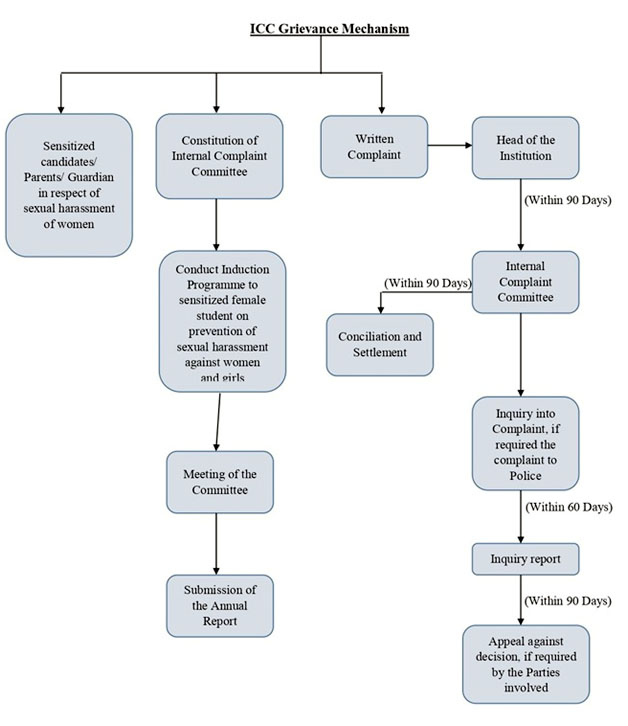
Mechanism of committee: The ICC addresses complaints of sexual harassment through a confidential process involving conciliation or inquiry, completed within stipulated timelines. It ensures fair redressal, conducts awareness programs, meets once a semester or as required, and submits an annual report to the authorities. Complaints can also be registered online through this link. Website Link- https://bbdnitm.ac.in/grievances/ (https://bbdnitm.ac.in/grievances/).
The Process for Complaint and Inquiry:
Step I:
An aggrieved woman should give a written complaint either in person or through post or email to the ‘Prevention of Sexual Harassment and Atrocities against Women Committee. The aggrieved should file the complaint within three months of the date of the incident. If the aggrieved woman is unable to make a complaint, her legal heirs may do so.
Step II:
On receiving the complaint, the ICC will inquire as per service rules or in their absence, according to regulations under the Act. The committee will complete them within 90 days. The committee will submit the report within ten days of the date of completion of the inquiry.
Step III:
If the ICC finds that the allegations against the respondent are proven, it will submit a report to the Principal to take action for sexual harassment as misconduct under the provisions of the applicable service rules or as per rules framed under the Act.
Step IV:
The college management will act on the recommendations of ICC within 60 days of the submission of the inquiry report.
Step V:
Appeal against the decision of the ICC is allowed within 90 days of the recommendations.
Role and Responsibility of Committee: The Internal Complaints Committee (ICC) functions as a statutory body under the Sexual Harassment of Women at Workplace (Prevention, Prohibition and Redressal) Act, 2013. Its role is to ensure a safe, secure, and gender-sensitive environment in the institution.
1. Preventive Role:
- To create and maintain a safe academic and working environment free from sexual harassment.
- To organize regular awareness and sensitization programs for students, faculty, and staff.
- To display notices, guidelines, and details of ICC members prominently on notice boards and the institutional website.
- To promote gender equity, respect, and dignity among the campus community.
2. Redressal Role:
- To receive, acknowledge, and register complaints related to sexual harassment.
- To maintain confidentiality while handling cases and ensuring fair opportunity to all parties.
- To conduct prompt, impartial, and thorough inquiries into complaints.
- To recommend suitable disciplinary action against the respondent, if found guilty.
- To facilitate conciliation, if requested by the complainant, without compromising her rights.
3. Advisory Role:
- To advise the Head of the Institution on preventive and corrective measures.
- To recommend changes in policies, rules, or infrastructure to strengthen women’s safety and dignity.
- To prepare annual reports on the number of cases received, actions taken, and awareness activities conducted, and submit them to the statutory authorities.
4. Supportive Role:
- To provide counseling and support services to aggrieved individuals.
- To guide complainants in approaching the police or legal authorities, if required.
- To ensure non-retaliation and protection for complainants and witnesses.
Convener Contact:
 | Name of Convener-Dr. Neha Gupta, Convener, BBDITM Email : [email protected]/[email protected] Mobile. : 8299500347/ 7678836555 |
About The Committee: In order to compliance with the Provisions laid down by the Scheduled Castes and the Scheduled Tribes (Prevention of Atrocities) Act, 1989, Act No. 33 OF 1989, dated 11/09/1989) & the Notification No. GSR – 316 (E) by Ministry of Welfare, New Delhi dated 31/03/1995 and as per the AICTE Directives to be adhered and followed by the Educational Institute in this regard, following shall be the SC-ST Committee of BBDITM.
Committee Members:
| Convener | Members |
| Mr. Ravi | 1. Dr. Anurag Tiwari 2.Dr. S. H. Abdi 3. Mr. Shivanand 4. Dr. SupriyaPhurailatpam 5.Mr. Gulab Chand (Lab Staff) |
| Frequency of Meeting | Once in a semester and as required |
Function of Committee: The following are the functions of the Committee.
- For prevention of atrocities against SC/ST students under the Act No. 33 of 1989, Scheduled Castes and the Scheduled Tribes
- To hear and resolve the issues/complaints if any; of such nature of Atrocity reported/complained.
- To counsel and guide SC/ ST students and help them to manage academic and personal issues of college life effectively.
- To aware the SC/ST students regarding various scholarships program of Central Govt., State Govt. and UGC
Mechanism of committee:
The SC/ST Cell was established in BBDITM to co-ordinate in the implementation of the various policies and programmes launched by the Central Government, MHRD, UGC and State Government for the benefit of the SC/ST students. The SC/ST committee shall endeavour to evolve a mechanism:
- To undertakes the activities to develop awareness among the SC/ST students, especially from the rural areas.
- To facilitate financial support to students from these communities from government agencies and other sources.
- To enrol for career orientation programs, to equip them with the necessary skills to choose a career option.
Role and responsibility of committee:
The Roles and responsibilities of the committee are as follows:
- To function as a Grievances Redressal Cell for the grievances of SC/ST students of the college and render them necessary help in solving their academic as well as personal career problems.
- To promote higher education among these two communities suffering economic, social and educational deprivation.
- To collect reports and information of Central Govt., State Govt. and UGC’s orders on various aspects of education, employment of SC/ST & OBC Students.
- To circulate Central Govt., State Govt. and UGC’s decisions about different scholarship programs.
- To communicate with the students and motivate them for better future planning
Convener Contact:
 | Name of Convener-Mr. Ravi Convener, SC ST Committee BBDITM Email : [email protected] Mob. :9958117477 |
About The Committee: Differently abled cell has been established in BBDITM with an objective to facilitate equal opportunities to ensure protection to their rights and enhance participation of differently abled person in various avenues without any discrimination. The cell endeavors to sensitize the college community to respect and cooperate with all differently abled persons at institute.
Function of Committee:
- To create an atmosphere of Equal Opportunity through awareness generation programs.
- To provide auxiliary support towards skill development and enhancing employability of students.
- To tailor development and sensitization programs to meet the distinct needs of the students.
- To expedite legal redressal in matters of violation of equal opportunity.
Committee Members:
| Convener | Members |
| Dr. Shailja Pandey
| 1. Dr. Rupali Agarwal 2. Mr. Shivanand 3. Ms. Garima Jain 4. Ms. Kajal Singh 5. Ms. RichaVerma 6. Mr. VivekNarain |
| Frequency of Meeting | Once in a semester |
Mechanism of committee: The Equal Opportunity Office has been committed to fulfilling its mandate of maintaining social harmony among various sections of the College community. Whenever any case of social discrimination is brought before the Equal Opportunity Office, it is thoroughly investigated and examined and suitable action is recommended. Addressing of issues related to any social discrimination faced by students or staff at any level is amongst the principal objectives of the Equal Opportunity Office.
Role and responsibility of committee: Following are the duties and responsibilities of Cell-
- Establishing coordination with government and non-government or and other funding agencies with an objective to provide financial support and other resources required for inclusion and educational empowerment of the students with disabilities.
- Undertaking suitable programs/plans, including remedial classes, assistive technology, and services for ensuring participation and improving performance of students with disabilities.
- Providing information about existing provisions and act as a counseling-cum-guidance center for students with disabilities, especially regarding academic, career and other matters.
- Taking initiatives to develop a socially conductive, accessible, and inclusive atmosphere for the development of healthy interpersonal relations among students with disabilities, academic and non-academic staff for academic interaction and extracurricular activities.
- Supporting the students with disabilities to overcome challenges and barriers originating from inequalities and discrimination at the College within its mandate.
- Taking necessary initiatives to make the infrastructures of the College barrier free or disabled-friendly.
- Organizing or conducting seminars/workshops/conferences/conferences/exhibitions/ special lectures/debates and alike, from time-to time, on various contemporary and significant disability related subjects for dissemination of knowledge and sensitization of the faculty members of the College about disability and allied aspects.
- Taking initiative to upgrade the Central Library of the College with modern devices and assistive technologies for enabling the students with disabilities to access information like their counterparts.
- Extending support to the students with disabilities to avail scholarships and stipends or financial assistance from governments and other agencies to support their education and other needs.
- Taking appropriate initiatives to ensure that the students with disabilities do have access to various provisions and facilities such as-
- 5% reservation of seats in all subjects at all levels;
- Reduction of 5% marks from minimum eligibility criteria;
- Age relaxation of minimum 5 years for admission;
- 30 minutes of extra time in the examinations;
- Scribe to those who are incapable of writing examinations due to disability;
- Full or partial exemption from the payment of admission and examination fees in special cases;
- Boarding and lodging at the College Hostels for both male and female students with disabilities.
Convener Contact-
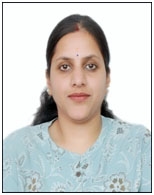 | Name: Dr. Shailja Pandey Convener, Equal Opportunity Cell (for Differently Abled Students/Staff), BBDITM Email: [email protected] Mob.:9415025571 |
About the Committee: Hostel and mess managementcommittee is responsible for the efficient functioning of the hostel and mess facilities at campus. Committee formed to manage the hostel and mess infrastructure and other initial facilities.
Functions of the Committee: The functions of Hostel and mess committee are listed below:
- To create overall disciplined environment in hostel.
- To provide them infrastructure conducive for their growth.
- To provide amenities for their recreation and past time.
- To create an environment so that feeling of home sickness is not there amongst the students.
- To provide good healthy and hygienic food.
Committee Members:
Under the Chairmanship of Director of the Institute, the Hostel and mess management committeeof BBDITM has been constituted as per the norms of AICTE and guidelines prescribed by NBA, with following members under varying categories.
| Convener | Members |
|
Mr. Abhay Yadav
|
|
| Frequency of Meeting | Twice in a Semester |
Mechanism of Committee:
Hostel and mess management committee shall evolve a mechanism and procedure for:
- Liaison Role:The committee acts as an intermediary, collecting student grievances and communicating them to the hostel authorities and administration.
- Operations & Maintenance: The committee monitors the daily functioning of hostel infrastructure, housekeeping, and mess facilities to ensure cleanliness, hygiene, and comfort.
- Coordination: The committee collaborates with mess contractors, hostel authorities, and administrative departments to ensure effective service delivery and issue resolution.
- Feedback Collection: Warden’s collect student feedback on food quality and service in the mess, and on general living conditions in the hostel.
Roles and Responsibilities:
The roles and responsibilities of the Hostel and mess committee are to:
- To create an overall disciplined environment in the hostel.
- To provide them with a favorable environment necessary for their growth.
- To provide amenities for their recreation.
- To organize various extracurricular activities and sports events in the hostel to bring out creative abilities of students.
- To create a homely environment.
- To provide good, healthy and hygienic food.
- The committee shall create a positive ambience in hostels.
- Promoting team spirit and cooperation amongst the students by creating a healthy environment.
- Motivating students for extracurricular activities and sports events.
- Proper maintenance of hostel and mess and to have a check on quality of food.
Convener Contact Details-
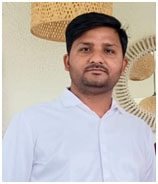 | Convener Detail: Mr. Abhay Yadav Convener, Hostel And Mess Committee BBDITM Email : [email protected] Mob. : 8707002622 |
About The Committee: The Infrastructure and Maintenance Committee shall focus on strategy and high-level policy related to infrastructure that are in line with the AICTE guidelines and therefore ensure that the physical assets are fit for that purpose, now and in the future.
Objective:
- To ensure adequate development, effective utilization, and proper maintenance of institutional infrastructure and physical facilities.
- To provide a safe, functional, and supportive environment for academic and administrative activities.
Function of Committee:
- To assess and plan infrastructure requirements such as classrooms, laboratories, library, and common facilities.
- To ensure regular maintenance and upkeep of buildings, electrical systems, water supply, and campus facilities.
- To monitor utilization and optimal use of institutional infrastructure and physical resources.
- To prepare and recommend budget proposals for infrastructure development and maintenance works.
- To supervise renovation, repair, and civil works in coordination with concerned departments/agencies.
- To ensure safety, cleanliness, and compliance with statutory norms related to campus infrastructure.
Committee Members:
| Convener | Members |
|
Mr. Achman Mishra
|
|
| Frequency of Meeting | Once in a Semester and as required |
Mechanism of committee:
- College has an effective and efficient infrastructure and maintenance system.
- Complaints received through digital, or paper mode can be entertained directly by the committee head.
- If any issue related to the additional course, the requirement of infrastructure, furniture and other facilities as per the AICTE norms, submitted to the committee.
- After making appropriate inclusion and exclusion in the prior requirement generated by the department the committee head forward same to the director institute.
- On receiving from the committee head director institute forward the same to the appropriate authority and other onward action.
- Accordingly, maintenance complaints which are raised by the respective departments also submitted through offline or online mode.
- After receiving the maintenance related complaints, the head of the committee forward to the maintenance department for onward action.
Role and responsibility of committee:
- To review and recommend updates to the campus master plan on a periodic basis
- Full fill the Norms prescribed by AICTE.
- Optimize the Resources to its best utilization.
- Regular Maintenance related to infrastructure should be done.
- To make recommendations to the BOG regarding campus space allocation to meetchanging institutional needs.
- To make recommendations on the prioritization of needs for renovation and repairs to campus facilities and infrastructure, including major technology components.
Convener Contact:
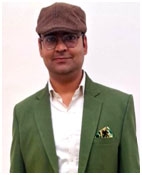 | Name of Convener- Mr. Achman Mishra Convenor, Infrastructure & Maintenance Committee – BBDITM Email : [email protected] Mob. : +91-80904 78278 |
About The Committee: The Cultural and Co-Curricular Activities Committee of BBDITM aims to indoctrinate and imbibe in the students the notion of Unity in Diversity and enable them to expand their academic and industrial skills. It endeavors to become a committee that can give a platform to the students to showcase their creative expertise while giving importance to the rich cultural heritage of the nation. This committee promotes and arranges extracurricular activities to bring out the talents of students in the performing arts and provide social service as well to the society by enhancing social skills among the students.
Objective:
The Cultural and Co-Curricular Activities Committee of BBDITM has been established to enhance confidence, shaping holistic personality, and developing extraordinary skills among the young students.
Function of Committee:
- Program and procedure practiced in the committee should remain confidential to the committee members.
- All the records and documentation should be maintained after every program.
- No use of offensive / abusive language is allowed within the committee program.
- Maintain cordial relationships within committee members.
- Unanimous decisions with prior discussion shall be made in the committee.
Committee Members:
| Convener | Members |
|
Dr.Pooja Singh | 1. Dr. Neha Pandey 2. Ms. Kajal Singh 3. Mr. Ravi Gupta 4. Mr. KamleshwarDharDwivedi 5. Mr. Diwakar Singh 6. Ms. Poonam |
| Frequency of Meeting | Once in a semester |
Mechanism of committee:
- Selection of Clubs Members
- Notification of extracurricular activities
- Performance of team at Inter and Intra Collegiate level
- Social Welfare activities to enhance social awareness
- Enhancing and boosting the technical skills among students
- Development of managerial talents among students
Role and responsibility of committee:
- The Cultural Committee shall be responsible for all intra and inter collegiate cultural events in the College.
- To plan and schedule cultural events for the academic year. (Tentative dates to be included in the academic calendar of the institute.) by delegating various tasks.
- To organize cultural events.
- To communicate about various festivals and events to be celebrated in the college and give a wide publicity.
- Arranging events/programs for staff and students in coordination with ‘Students Cultural Committee’.
Convener Contact:
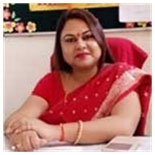 | Name of Convener- Dr. Pooja Singh Convener, Cultural and Co-Curricular Activities Committee, BBDITM Email : Email: [email protected] Mob. : 9415434686 |
About The Committee: The Examination & Time Table Committee is a key of academic body of the institution responsible for the effective planning, coordination, and execution of all academic and examination-related activities.This committee works under the guidance of the Director and in coordination with the Controller of Examinations (COE), Heads of Departments, and Program Coordinators, ensuring smooth conduct of internal assessments, university examinations, and regular academic schedules.
Objective:
- Smooth and Fair Conduction of internal / External Examination (AKTU) is the principal objective of Examination Committee.
- The Committee has demonstrated its perseverance and competence by quickly conducting several additional AKTU examinations.
- To publish the results and take necessary steps for the conduct of supplementary exams in time.
- To address the grievances/ complaints of the students and staff concerning exam-related issues.
- Prepare the timetables in the prescribed format at the beginning of every semester.
- Every activity is planned according to the timetable and calendar.
- To collect information on various academic/curricular and extension activities planned by various committees.
- To coordinate the timetable preparation for each department by respective HODs in every semester.
- Committee consists of one senior faculty as a Convener and one faculty member from each department.
Function of Committee:
I. Examination-Related Functions:
- Ensure the smooth conduct of internal examinations (sessionals, internal assessments, etc.) as per the academic calendar.
- Coordinate with the university (e.g., AKTU) for the conduct of external/semester examinations.
- Prepare and display internal exam schedules, seating plans, and invigilation duties.
- Collect, verify, and submit internal marks, practical marks, and attendance records to the university as per the schedule.
- Maintain confidentiality and integrity in all examination-related matters.
- Address and resolve student grievances related to internal assessments.
II. Time Table-Related Functions:
- Prepare and circulate centralized academic timetables for all departments and semesters.
- Coordinate with departments to avoid clashes in classroom and laboratory usage.
- Incorporate changes in faculty availability or infrastructure into the timetable dynamically, as needed.
- Ensure optimal utilization of classrooms, laboratories, and faculty resources.
- Publish and maintain updated master timetables for regular, remedial, and extra classes.
Committee Members:
| Convener | Members |
|
Mr. Shivanand | 1.Mr. Abhay Yadav 2. Ms. DiptiRanjan 3. Mr. Manish Singh 4. Mr. Pankaj Verma 5. Mr. KamaleshwarDharDwivedi 6. Mr. Fazlur Rahman 7. Dr. Abhishek Madheiya 8. Mr. Kamlesh Kumar 9. Mr. Kishan Kumar 10. Mr. Shakti Singh 11. Mr. Shahab Ahmad 12. Mr. Dharmesh Kumar |
| Frequency of Meeting | 06 in a Year |
Mechanism of committee:
Director
↓
Examination & Time Table Committee Coordinator
↓
Committee Members: Faculty from all Departments
↓
──────────────────────────────────────────────
Time Table Planning Internal Exam Planning External Exam Coordination
↓ ↓ ↓
Timetable Finalization Exam Schedule Finalization University Guidelines
↓ ↓ ↓
Classroom & Lab Allocation Invigilation Duties Seating Plan / Logistics
↓
Execution & Monitoring of Classes and Examinations
Role and responsibility of committee:The Examination & Time Table Committee plays a vital role in the academic framework of the institution. It ensures timely conduct of examinations and smooth implementation of academic schedules.
I. Roles:
- Policy Implementation:
Implements examination and timetable policies in accordance with university regulations and institutional requirements. - Academic Coordination:
Acts as a bridge between departments, faculty, and administration for academic scheduling and examination-related matters. - Quality Assurance:
Maintains transparency, fairness, and academic integrity in the conduct of exams and class schedules.
II. Responsibilities:
- Prepare and publish centralized academic and examination timetables.
- Coordinate with HoDs and faculty for subject allocation and lecture scheduling.
- Organize internal exams (sessionals, practicals, etc.) as per academic calendar.
- Allocate classrooms/labs and assign invigilation duties.
- Ensure smooth and disciplined conduct of internal and university examinations.
- Monitor timely submission of attendance and internal marks on ERP/University portal.
- Maintain records of examination results, attendance, and timetables.
Convener Contact:
 | Name of Convener- Mr. Shivanand Convener, Examination & Time Table Committee BBDITM Email : [email protected] Mob. : 8081443803 |
The Budget Committee is an important committee of the institute responsible for recommending budget priorities, procedures, and processes to the College Director. The Budget Committee functions with the help of all the department representatives.
Objective:
- To prepare a comprehensive institutional budget reflecting academic and administrative needs.
- To ensure optimal allocation and efficient utilization of financial resources for quality education and institutional development.
Functions:
- To collect the budget from different departments under the recurring and non-recurring category.
- To finalize the budget after deletion of certain items.
- Proper monitoring and distribution of budget in different departments.
- Arranging Meeting with departmental budget representatives/heads/PCs.
Mechanism: The Following are the steps involve in preparing Budget.
- The Proposed recurring and non-recurring budget of department has been send by HODs to the Budget Committee Co-Convener.
- On receiving of proposed budget a meeting has been called by the co-convener of committee.
- Compilation and selecting of proposed budget items under various head has been finalized by the budget committee with the best of his knowledge.
- Final Budget has been send to the Director Institute for approval and onward action.
Following are the Budget Preparation Committee Members:
| Convener | Members |
| Dr. Neha Gupta |
|
Role and Responsibilities:
- To coordinate with department heads for accurate and justified budget requirements.
- To analyze expenditure trends and suggest cost-effective measures.
- To ensure budgetary provisions support academic excellence and infrastructure needs.
- To monitor approved budget implementation and report va
- To facilitate financial planning for future institutional growth.
Convener Contact:
| Name of Convener- Dr. Neha Gupta, Convener, BBDITM Email: [email protected]/[email protected] Mobile. : 8299500347/ 7678836555 |
About The Committee: Advises and reviews library policies for instruction, resources, services, and the facility.
Function of Committee: The Library Committee meets once in a semester to discuss various issues related to Library facilities and services and advises suitable solutions for better functioning. It acts as an internal auditor for quality checking and provides support and guidance. To render the library user-friendly, the committee meets regularly to discuss and finalize proposed policies, budget, specific issues and suggestions to the library. The committee also studies the library needs and issues of its maintenance.
- Guides the Librarian in formulating general library policies and regulations which govern the functions of the library.
- Works towards modernization and improvement of Library and documentation Services.
- Formulates policies and procedures for efficient use of Library resources.
- Prepares budget and proposals for the development of the Library.
- Seeking feedback on Library functions and service from readers.
- Maintain adequate library facilities for optimum use
- Lay down the rules & regulations.
- Procuring relevant books & subscribe related periodicals/Journals, and Electronic Resources.
- Prepare the annual budget, rules and regulations of the library
Committee Members: Under the Chairmanship of Director of the Institute, the Library and Learning resource Committee of BBDITM has been constituted as per the norms of AICTE and guidelines prescribed by NBA
| Convener | Members |
|
Mrs.Rekha Agarwal(Librarian) | 1.Mr. Vineet Agarwal 2. Ms. Keetri Mishra 3. Ms.Poonam 4. Mr.KamaleshwarDhar 5. Dr. Apoorva Srivastava 6. Ms. Kajal Singh |
| Frequency of Meeting | Twice in a year |
Mechanism of committee: Library encourages faculty and librarian partnerships to ensure that the collections remain dynamic and meet evolving curricular needs.
Role and responsibility of committee: The library committee reviews and recommends Policy for the Library, with particular attention to the collection budget and to the distribution of resources among academic divisions and units.
- Work as an ambassador between the department and library, students and faculty in the department and library.
- Provide the faculties and students in a department with a sense of ownership of the library.
- collecting the requirements of Books and Journals and study materials from the faculties of respective departments based on current requirements, compiled in proper form and recommend for procurement through the head of department.
- Assisting in the administration and implementation of different activities for improving overall library usage.
- Creating awareness amongst the students and faculties in the department about intellectual property right and plagiarism related issues.
- Initiate and host events in the library such as Book Exhibition, world book day, library orientations for fresher’s, awarding students for best library user etc.
- Communicating difficulties, if any, students and faculties of the department are facing in using library facilities.
Convener Contact:
 | Name of Convener- Rekha Agarwal (Librarian) Convener, BBDITM Email : [email protected] Mob. : 8707232503 |
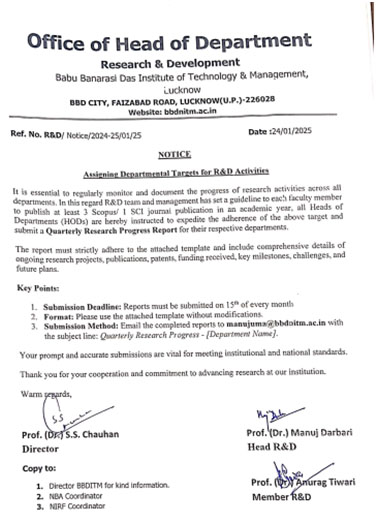
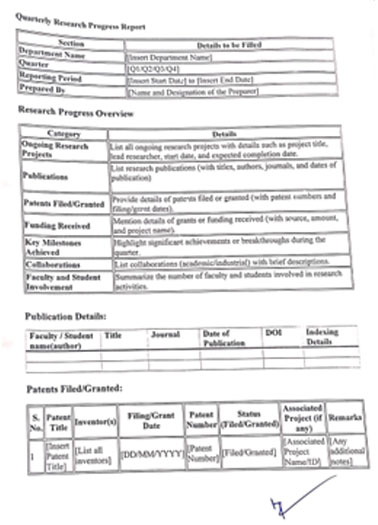
About The Committees: The Institute has established a research and development committee to offer specialized administrative and managerial assistance for the management of sponsored research, consulting, and other R&D-related activities. Institute R and D members selected from all the branches who promote the culture of research at department level as well to promote Research amongst Faculty Members in the form of Quality publications and Patents.
BBDITM has established IP Cell to nurture the spirit of innovation and translate these into products, processes, and services for commercial exploitation in wider public goods. BBDITM encourages all faculty, staff and students to document their IPs, so that these could be safeguarded and utilized for the benefit of nation, the institute and inventors. All employees of BBDITM should inform the IPR cell about any IPRs before filing them either through the cell or through any other means.
Objectives
Objectives of Research & Development Committee(R&D)
- To create zeal amongst students and faculty members towards research and innovation.
- To promote project labs
- To monitor progress of the research and development activity.
- To work closely with the industrial needs that eventually will result in new or improved products, processes, systems or services that can increase the company’s productivity.
- To foster collaborations for mutual benefits and to maximize industrial connectivity.
- To establish collaboration with other universities, public and private sectors and identify R &D projects including consultancy services which could be undertaken at the institution.
- To promote research in various departments of the Institute.
- To ensure smooth functioning and effective management of R&D at the institution.
- To motivate students for presenting papers in National and International conferences and projects in competitions Interdepartmental / collaborative work to be encouraged.
Objectives of Intellectual Property Right (IPR)
- To promote innovations in the areas of technology, sciences, and humanities by nurturing new ideas, research, and scholarship in an ethical environment.
- To create an awareness about IPR / Patent drafting and filing for faculty members, research scholars and students.
- Monetization of the IP assets in the College
- To safeguard intellectual property (IP) rights generated by faculty, students, and staff of BBDITM, by translating their creative work into IP rights, with least possible conflict of interest.
- To organize guest lectures / webinars / workshops and training course on IPR.
- To lay down an efficient, fair, and transparent administrative process for ownership control and assignment of IP rights and sharing of revenues generated by IP, created and owned by BBDITM, Lucknow.
- To spread awareness on intellectual property among the faculties and students at the college by organizing workshops, seminars, and training programs.
- The cell also accelerates the faculties and students in obtaining and enforcing IPRs in the form of patents, copyrights, Trademarks, Industrial Designs, etc.
- The IP Cell provides technical and financial assistance to the faculties and students of the college.
Function of Committees:
- To promote research, innovation, and creativity among faculty and students.
- To organize workshops, seminars, and awareness programs on research and IPR.
- To identify and support research in emerging and interdisciplinary areas.
- To guide the preparation and submission of research proposals to funding agencies.
- To monitor and facilitate ongoing research and development projects.
- To assist in identification, documentation, and filing of patents and other IPRs.
- To ensure ethical practices and compliance with plagiarism policies in research.
- To formulate and periodically review institutional research and IPR policies.
- To establish collaborations with industries and R&D organizations for joint projects.
- To encourage technology transfer and commercialization of research outcomes.
- To maintain records of publications, patents, funded projects, and report progress to authorities.
Committee Members for Intellectual Property Right (IPR), Research & Development Committee:
| Convener | Members |
| Dr. ManujDarbari | 1. Dr. SupriyaPhurailatpam 2. Dr. Apporva Srivastava 3. Dr. Abhishek Madhesia 4. Dr. Vinayak 5. Dr. Usha Sharma 6. Dr. Neha Gupta 7. Ms. Poonam Singh 8. Mr. Rohit Agarwal |
| Frequency of Meeting | Once a Semester and when required |
Mechanism of committee
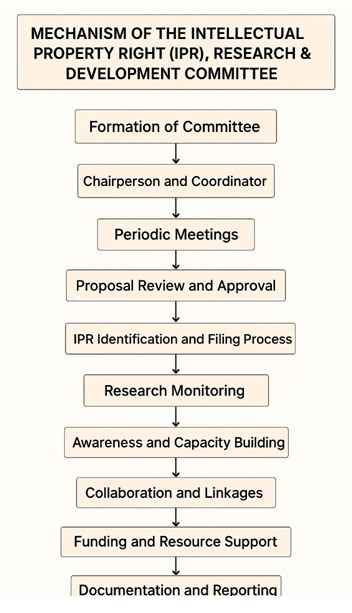
Role and responsibility of Committees:
- The committee shall promote research and development activities by motivating students and members of faculty for publishing research papers
- Motivating them to get patents for their work
- To organize regular seminars and workshops on emerging trends and technologies with a special focus on innovations
- To organize regular industrial training for the students commensurate with market needs.
- To organize regular industrial visits for the students
- To organize conference on innovations every year.
- Each Department has R&D coordinators to disseminate the research at the Department al levels and convert the students’ project into quality publication and patents.
- The Institute is committed to promoting, protecting, managing and commercializing Intellectual Property consistent with the recognition that among its primary objects and functions are teaching, research and meeting the needs of the community and society.
- It supports the commercialization and exploitation of IP, which can provide an additional source of revenue to the Institute and also accrue benefits to staff and students. At the same time, the Institute recognizes traditional academic values and expectations.
Convener Contact:
 | Name of Convener- Dr. Manuj Darbari, PhD (Info Sc.), PhD (Buss. Admn), PhD (Law) Convener, R&D and IPR BBDITM, Lucknow Email: [email protected] Mob.: 9918594881 |
About The Committee: The Sports and Fitness Committee is established to promote physical well-being, team spirit, and holistic development of students and staff by organizing sports activities, fitness programs, and wellness initiatives. It works to integrate physical education with academics and ensures active participation in intra- and inter-collegiate events.
Function of Committee:
- This activity should promote active participation from students and staff in sports, games, yoga, and fitness activities to improve physical as well as mental well-being.
- Organize annual sports meets, inter-class tournaments, friendly matches, and facilitate participation in inter-collegiate and university competitions.
- Maintain and upgrade sports facilities—indoor and outdoor, gymnasiums, and ensure availability of required equipment.
- Arrange professional coaching sessions and identify, train, and nurture talented athletes.
- Conduct health and wellness programs including yoga, meditation, aerobics, fitness workshops, and health awareness camps.
- Prepare and implement the annual sports activity calendar and manage budgets for events, training, and equipment procurement.
- Encourage holistic development, teamwork, leadership, and sportsmanship among students through structured sports initiatives.
Committee Members:
| Convener | Members |
|
Dr. Anil Kumar | 1. Mr. Vinayak 2. Mr. Ashish Verma 3. Mr. Anurag Srivastava 4. Mr. Diwakar Singh 5. Mr. Abhishek Dubey |
| Frequency of Meeting | Two meetings each semester |
Mechanism of committee:
- The committee is constituted from the Chairperson (Head of Institution), Convener (Physical Education Director/Sports Officer), faculty members, student representatives, and administrative staff.
- It prepares an Annual Sports & Fitness Calendar, identifies infrastructure needs, allocates budget and resources accordingly.
- It sends the proposed plan and budget to the Head of the Institution/Management for approval of activities and funds.
- The committee executes activities by organizing practice sessions, tournaments, fitness workshops, and coordinating external competitions.
- Faculty coordinators and the Sports Officer are in charge of ensuring the success of the events, record participation, achievements, and other aspects of the event.
- Program results are evaluated by the committee, excellence is recognized, and an annual program report is prepared.
- Student and staff feedback is gathered to improve facilities, coaching, and event planning for the following academic year.
Duties and Responsibilities
- From each department a Faculty Co-Ordinator is taken and appointed on various sports event for fair selection and formation of team.
- To build zeal amongst students and faculty members towards sports.
- To assure smooth conduction of sports fest or event within the college.
- To provide a record of sports and other games events participated by students within the college and outside of the college or state.
- To provide essential infrastructure for sports.
Convener Contact:
 | Name of Convener- Dr. Anil Kumar,Associate Professor, BBDITM Email : [email protected] Mob. : 9450736616 |
About the Committee- Ministry of Education (MoE), Govt. of India has established ‘MoE’s Innovation Cell (MIC)’ to systematically foster the culture of Innovation among all Higher Education Institutions (HEIs). The primary mandate of MIC is to encourage, inspire and nurture young students by supporting them to work with new ideas and transform them into prototypes while they are informative years.
MIC has envisioned encouraging creation of ‘Institution’s Innovation Council (IICs) across selected HEIs. A network of IICs is established to promote innovation and entrepreneurship in the Institution through multitudinous modes leading to an innovation promotion ecosystem in the campuses. MIC has established Institution’s Innovation Council in 16329 Institutions till September 2025 across 28 States and 9 Union Territories.
MIC will focus on creating complete ecosystem which will foster the culture of Innovation across all educational institutions from ideas generation to pre-incubation, incubation and graduating from the incubator as successful start-ups. MIC will also work on designing ranking system to identify institutions in the forefront of innovation.
Ministry of Education has established ‘MoE’s Innovation Cell’ with the mandate to work closely with our Higher Education Institutions (HEIs) to encourage the creative energy of our student population to work on new ideas and innovation and promote them to create start-ups and entrepreneurial ventures.
Entrepreneurship Development Cell of BBDITM will be dedicated to the cause of promoting entrepreneurism among the students. We work to establish a startup ecosystem and provide young entrepreneurs a platform to work out on their ideas and motivate them for this adventurous journey of building a startup from scratch.
Our students are motivated to take benefits from the different initiatives taken by the government such as Startup India, Make in India, Digital India, Smart Cities, etc. and contribute effectively in nation building.
We invite various eminent entrepreneurs to deliver lectures and educate students about the joys and hardships of entrepreneurship. Our aim is to bring the innovative ideas out of the young and ignited minds of our college and nearby to help them with it.
We promote visionary thinking among the entrepreneurs-to-be. Developing and fostering entrepreneurial attitude and building the support mechanisms that give momentum to these activities. Entrepreneurial spirit is the part and parcel of our work at the Entrepreneurship Development Cell of BBDITM.
ED Cell has been named as ELITE Club
Tagline: Empowering yourself is Empowering India
Function of IIC:
Fostering an innovation ecosystem: It creates a supportive environment for new ideas to grow and develop. It carries out various activities related to innovation, intellectual property rights, and entrepreneurship as directed by MIC within a set timeframe.
Organizing events: The IIC conducts workshops, seminars, hackathons, idea competitions, and mini-challenges with industry participation. It organizes hackathons, idea competitions, and mini-challenges with the involvement of industries.
Mentorship: It builds a network of mentors to guide student innovators.
Networking: The IIC connects with peer institutions and national organizations focused on entrepreneurship development.
Promoting projects: It showcases innovative projects by faculty and students on the institution’s innovation portal.
Sharing success stories: The IIC identifies and shares the achievements of innovators to motivate others.
Function of ED Cell:
To be a self-sustained in due course Entrepreneurship Development Cell catering to the needs of young, ignited entrepreneurs and startups with innovative ideas related to national/international importance and social needs.
Developing an entrepreneurial mindset: The goal is to foster an environment where students are inspired to think and act like entrepreneurs.
Turning ideas to startups: The ED Cell plays a crucial role in transforming innovative ideas into thriving businesses.To provide suitable infrastructural support for the development of start-ups and their rapid growth.
Equipping with business knowledge and skills: It equips students with essential entrepreneurship skills through a variety of development activities.
Building a support system: The ED Cell provides mentorship, resources, and a supportive platform for students to kickstart their ventures.
Facilitating market access: It can assist with market research, preparing project reports, and evaluating technical feasibility. Encourage students to take up visits to Industry, rural places and hospitals.
Connecting with resources: The ED Cell keeps students informed about the wide range of resources available for starting their own businesses.
Committee Members:
Under the Chairmanship of Director of the Institute, Institution’s Innovation Council (IIC) and Entrepreneurship Development Cell of BBDITM has been constituted as per the norms of AICTE and guidelines prescribed by NBA, with following members under varying categories.
| Convener | Members |
|
Mr. Shahab Ahmad | 1.Mr. Anurag Srivastava 2. Dr. Abhimanyu Yadav 3. Dr. Apoorva Srivastava 4. Mr. Shakti Singh 5. Ms. SoumyaSaxena 6. Mr. Rajeev Srivastava 7. Mr. Ajay Kumar 8. Mr. Mohammad Aquib |
| Frequency of Meeting | Twice in year |
Mechanism of committee:
Institution’s Innovation Council (IIC)-
Promoting innovation and entrepreneurship-related activities: Encouraging a wide range of innovation and entrepreneurship-related activities, including:
- Brainstorming and tackling real-world problems
- Embracing Design Thinking and developing Proof of Concepts
- Understanding and protecting Intellectual Property (IP)
- Hosting workshops, seminars, and connecting with entrepreneurs and investors
- Organizing hackathons, idea competitions, and fun mini-challenges
- Providing support for pre-incubation and incubation stages
Ecosystem Building:
- Building a supportive network of mentors for student innovators.
- Engaging with other IICs, industry professionals, and organizations focused on entrepreneurship development.
Capacity Building & Recognition:
- Training and appointing people to foster innovation.
- Acknowledging and celebrating innovative projects and best practices.
Scoring & Rating:
A system where IICs can earn marks and stars for consistently hitting their activity targets, with extra rewards for those standout moments.
Purpose and Impact:
The main aim of the IIC mechanism is to foster a vibrant innovation and entrepreneurship ecosystem in higher education institutions. By actively involving both faculty and students, it seeks to nurture a culture of innovation, safeguard new ideas, and encourage the spirit of startup creation.
Entrepreneurship Development Cell –
Awareness Programs: We run engaging awareness campaigns and motivational programs designed to spark an entrepreneurial spirit and culture among students.
Training & Support: We organize hands-on training sessions and offer guidance on key areas like crafting business plans and navigating project approvals.
Industry Linkages: We build strong partnerships with industries, research institutions, and various organizations to foster collaboration and share resources.
Events & Competitions: We host exciting pitch competitions, start-up fairs, and guest lectures to highlight student innovations and provide real-world experience.
Mentoring Sessions: We hold regular mentoring sessions led by seasoned faculty and industry experts to support students at every step of their entrepreneurial journey.
Partnerships: We team up with financial institutions, banks, and government agencies to assist students in securing the funding they need for their ventures.
Role and responsibility of committee:
The roles and responsibilities of the IIC & EDC:
- Faculty Representation:
1.1. President (Head of the Institute):The President will constitute the IIC council and appoint its members. He is responsible for ensuring that Quarterly Council Meeting is planned effectively. Conduct Council Meeting in accordance with prescribed rules and that matters are dealt with in an orderly, efficient manner.
1.2.Convenor:The Convenor will work in close coordination with IIC president and will provide help wherever required for smooth conduction of activities.
1.3. Innovation activity coordinator: Will work to promote innovation related activities on campus or as mandated in IIC council meeting.
1.4. Start-up activity coordinator: Will work to boost startup generation among students and related activities or as mandated in IIC council meeting.
1.5. Internship coordinator: Will work to arrange student internships in startups, so to expose them with startup ecosystem in India, real-life challenges in startup and their success stories or as mandated in IIC council meeting.
1.6. IPR activity coordinator: To promote awareness about IPRs and conduct related activities on campus or as mandated in IIC council meeting.
1.7. Social Media Coordinator: Will create and manage IIC page/account on Facebook, Twitter and YouTube and other relevant social media platforms. He / She will be responsible for posting all the relevant information about council meeting resolution and action plan, IIC activities and follow/tag MIC/IIC page and posts on these platforms. He/ She will also ensure that all students follow MIC/IIC page/account on social media to get first-hand information.
1.8ARIIA Coordinator: Coordinate for ARIIA related activities.
1.9 NIRF coordinator: Coordinate for NIRF related activities.
- Expert Representation:
- Student Representation:
Faculties, Experts and Studentsrepresentationin IIC& EDCwill serve as a bridgeamong stake holders of the institute.
Student coordinators will act as a medium of communication between IIC& EDCand institute students. They will understand the concept, idea and method of participation in IIC activities and disseminate it to all the students. They will act as a volunteer for IIC & EDC programs and will support respective faculty coordinators.
Convener Contact-
 | Name: Mr. Shahab Ahmad Convener, IIC & EDC BBDITM Email: [email protected] Mob.: 9602924306 |
About The Committee: The Training Placement, Industry Interaction & Career Guidance committee is a committed body in educational institutions that serves as a significant entity to prepare students for smooth transitions into professional lives, bridging academia and industry, and guiding students in all aspects of their personal and professional growth.
Function of Committee:
- Regular training sessions which include personality development workshops, aptitude and technical training, communication and interview skills programs, and resume-building workshops are conducted.
- Provides the platform for seminars, webinars, and workshops on career planning, industry trends, and job market dynamics.
- Campus placements are facilitated, application and interview processes are supported, and the entire coordination of recruitment drives is handled.
- Campus-industry collaborations are set up, which include creating and maintaining relationships with companies for internships, job openings, and industry expert engagements.
- Job openings, competitive exams, and further study options are communicated through both online and offline mediums by the office.
- Students are assisted in short-term and long-term career mapping and planning through the provision of counseling and mentorship sessions.
- The institution facilitates the holistic development of students by conducting activities that promote teamwork, leadership skills, adaptability, and critical thinking.
Committee Members:
| Convener | Members |
| Mr. Anurag Shukla Convener
| 1. Ms. ArchanaDwivedi 2. Mr. Praveen Kumar Pandey 3. Mr. RudendraBahudur Singh 4. Mr. Saurabh Kumar Jain 5. Mr. Arvind Gautam 6. Mr. Navneet Kumar Pandey 7. Mr. Shakti Singh 8. Mr. Navneet Yadav |
| Frequency of Meeting | Twice in a year |
Mechanism of committee: ( Please attach a flow chart, if available)
- Providing comprehensive career counseling and guidance to enable students to make informed career choices based on their skills and aspirations.
- Enhancing employability through the development of soft skills, technical training, and aptitude workshops.
- Facilitating internships, industrial visits, and live projects that provide real-world industry exposure.
- Coordinating and organizing campus recruitment drives by liaising with reputed organizations.
- Bridging the gap between academic knowledge and industry requirements through regular industry interaction.
Role and responsibility of committee:
- Plan and execute career awareness and skill development programs.
- Keep good relations with the industry for internships and placements.
- Facilitate internships, industrial visits, and live projects.
- Provide the latest updates on jobs, internships, competitive exams, and higher education opportunities.
- Help students in resume writing, interview skills, and soft skills.
- Coordinate the efficient running of campus recruitment drives and placement activities.
Convener Contact (Details for website)
 | Name of Convener- Mr. Anurag Shukla Convener, Training Placement, Industry Interaction & Career Guidance Committee BBDITM Email : [email protected] Mob. : 8765681423 |
Value Education and Ethics Cell BBDITM, offers a new way of thinking about education and how students can be supported to develop to become successful and happy members of the global society. It encourages reflective and inspirational attributes and attitudes. They can be nurtured to help people, discover the very best of themselves which enables them to be good global citizens and prepare them for their working life. Value Education Cell develops a secure sense of ‘SELF’. Students become more empowered to take responsibility of their own learning. They develop academic diligence when they are involved with a value based education. They develop rational trust. They become articulate and able to talk freely and well through silence and quietude in a value based framework.
Function of Committee:
- Inculcation of good manners
- Building character and belief in oneself and belief in God
- Equipping students to make decisions based on sound moral principles
- Developing the concept of equality and respect for all people
- Developing a sense belongingness and inclusiveness and integration
- Inculcating good citizenship behavior
- Being tolerant to those with different belief
Members Value Education Committee:
| Convener | Members |
| Dr. Kaushal Yadav | 1. Dr. Neha Pandey 2. Ms. Poonam 3. Mr. Ravi Gupta 4. Dr. Ruchi Singh 5. Dr. Apoorva Srivastava 6. Mr. Aamir 7. Dr. Shweta Gupta (Member Secretary) |
| Frequency of Meeting | Twice per semester or as needed. |
All the members of the Value Education Cell participated and instructed students regarding the relevance of values and value based living. The program was quite successful. The endeavor to inculcate right understanding about UHVPE subject was achieved. It was the rigorous efforts of the VE Cell team which made the program effective. Several extracurricular activities along with the lectures on UHVPE were conducted. Tree plantation, painting, sketching, music, dance, nukkadnatak and various literary events were organized for Ist year students. Students showed their keen interest and participated in these activities with great zeal. The purpose to bring about natural expression of cooperation among students proved fruitful by this Induction Program.
Mechanism of Committee:
- Conduction of FDPs
- Student workshop
- Attending Monthly meetings conducted by AICTE
- International and National Conferences
- Working as NCCP-IP member of AICTE
- Conduction of Student Induction Program as mandate of AICTE
Mechanism of Committee:
- Conduction of FDPS
- Student workshop
- Attending Monthly meetings conducted by AICTE
- International and National Conferences
- Working as NCCP-IP member of AICTE
- Conduction of Student Induction Program as mandate of AICTE
Policy: The important policy of the committee is to take regular classes on UHVPE and conducting workshop.
Policy: The important policy of the committee is to take regular classes on UHVPE and conducting workshop.
Role and responsibility of committee:
- Helping students to better understand the values that guide their daily life and contributing to changes in values held collectively by communities and personally by individuals.
- Development of students in physical, mental, and emotional aspect.
- To inculcate good manners, responsibilities of good citizen and develop respect for the dignity of individual and society.
- Enable the students to make decisions on the basis of enlightened Self.
- Conduct various workshops and seminars by eminent personalities for students as well as faculty members.
Convener Contact:
 | Name: Dr. Kaushal Yadav Convener, Value Educaiton Cell, BBDITM Email : [email protected] Mob. : 9198000963 |
The Website and Media Committee of BBDITM is responsible for maintaining the institution’s online presence, ensuring timely updates of academic, research, and event-related content. It acts as a bridge between the institution and public, reflecting the achievements, innovations, and activities of students and faculty. The committee ensures transparency and visibility aligned with NBA communication and quality dissemination standards.
Objective:
- Identify strategic initiatives for the website and present it to higher management for review and update.
- Develop a priority listing of desired design and functionality enhancements
- Identify to update and enhance website design and content.
- Coordinating with other committees in posting relevant information.
- Web Cell holds a meeting of the committee members on regular basis
- Various types of events are published under the media cell.
- Media cell is also responsible in covering the functions and important events conducted at the Institute.
- Cell also engages in monitoring the events, activities and participation from the institute.
Functions of the Committee:
- Manage and update institutional website content regularly.
- Ensure accuracy and consistency of information published online.
- Promote academic, cultural, and placement achievements through digital media.
- Coordinate with departments to collect news, notices, and achievements.
- Maintain visual identity and branding as per institute standards.
- Collaborate with the Media Cell for coverage of major events.
- Support NBA/NAAC data publication and compliance visibility.
Members Website and Media Committee:
| Convener | Members |
|
Dr. DiwakarYagyasen
|
|
| Frequency of Meeting | Twice in a semester and as required |
Mechanism of Committee –
The committee operates under the guidance of the Director and coordinates with departmental coordinators to collect verified information for upload. The review cycle includes content approval, website update, and media coverage documentation for institutional archives.
Roles and Responsibilities:
- Ensure correctness and timeliness of published content.
- Enhance institutional visibility through online media.
- Maintain a structured record of digital communications and event postings.
- Collaborate with departments to highlight faculty and student achievements.
- Monitor digital engagement and website analytics for continuous improvement.
Convener Contact Details:
 | Name: Dr. DiwakarYagyasen, Convener, Alumni Committee, BBDITM Email : [email protected] Mob. : 8127509234 |
BBDITM in collaboration with BBD University has established a self-financing Unit under NSS scheme to promote social well-being among community at a large. The Cell spread awareness about various developmental plans, environmental issues, health, and education avenues to all the sections of society.
The main objectives of National Service Scheme (NSS) are:
- understands the community in which they work
- understand themselves in relation to their community
- identify the needs and problems of the community and involve them in problem-solving
- develop among themselves a sense of social and civic responsibility
- utilizes their knowledge in finding practical solutions to individual and community problems
- develop competence required for group-living and sharing of responsibilities
- gain skills in mobilizing community participation
- acquire leadership qualities and democratic attitudes
Following are the members of Cell:
| Convener | Members |
|
Dr. Rishabh Dev Singh |
|
Mechanism of Committee:
Institutional Level:The local NSS unit is the main point of contact with the community.
College Advisory Committee: Chaired by the college Director, this committee meets at least half yearly to plan and review activities.
Program Officer (PO): A faculty member appointed as the PO organizes and implements all NSS activities under the guidance of the Director.
Students Leaders and Volunteers: Student leaders assist the PO in organizing and executing projects, while volunteers participate in the activities.
Duties and Responsibilities
- The major duties and responsibilities of the cell include work in rural areas, adopted villages and school to the serving the cause of society through survey, education and health awareness programme.
- The cell also focused on production-oriented programs.
- The cell participates in various youth programs, republic day and Independence Day parade, youth festivals etc.
Convener Contact Details:
 |
| Name: Dr. Rishabh Dev Singh Convener: NSS, BBDITM, Lucknow |
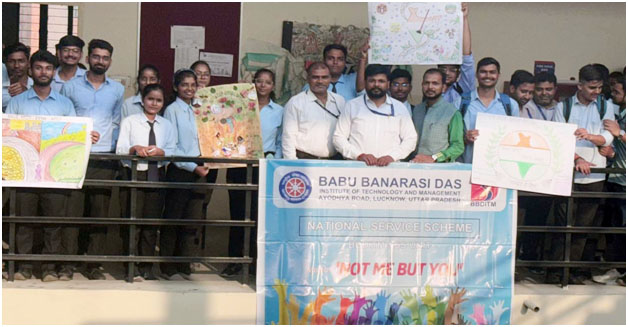
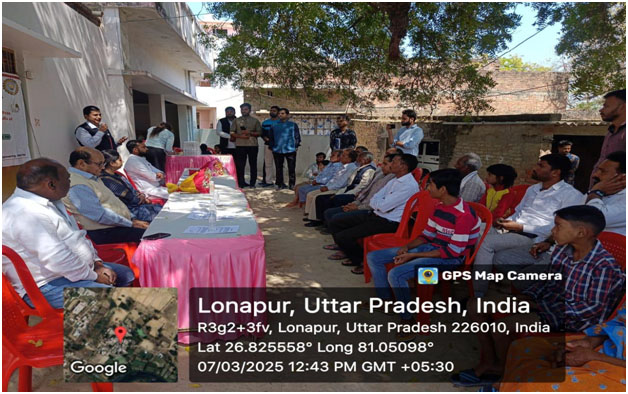
About The Committee:
An Innovation and Incubation Cell (IIC) is a specialized center established in educational institutions, universities, or organizations to nurture innovative ideas, support entrepreneurship, and encourage startups. It acts as a bridge between academia, industry, and entrepreneurs, creating an ecosystem where new ideas can be developed into viable products, services, or ventures.
Function of Committee:
- Formulate and implement policies related to innovation, incubation, startups, and funding in alignment with AICTE and Startup India guidelines.
- Prepare and execute annual innovation plans, identify priority research areas, and collaborate with industries and government agencies.
- Screen, select, mentor, and provide pre-incubation and incubation support to transform ideas into viable startups.
- Organize workshops, hackathons, bootcamps, and training programs to build entrepreneurial and innovation skills among students and faculty.
- Mobilize resources by facilitating funding through government schemes, CSR funds, angel investors, and venture capital support.
- Support Intellectual Property Rights (IPR) activities including patent filing, copyright, trademark guidance, and commercialization.
- Monitor and evaluate startup progress, track outcomes (startups, patents, jobs), and strengthen outreach through industry networking and MoUs.
Committee Members:
| Convener | Members |
|
Dr. Anil Kumar |
|
| Frequency of Meeting | Two meetings each semester |
Mechanism of committee: ( Please attach a flow chart, if available)
Idea Generation & Identification
- Students/faculty submits ideas through innovation challenges, hackathons, workshops, or open calls.
- Committee evaluates feasibility (technical, market, and social impact).
Screening & Selection
- Screening committee (faculty + industry experts) shortlists ideas.
- Criteria: innovation, novelty, market potential, scalability, sustainability.
Pre-Incubation Support
- Provide mentoring, lab access, and guidance to convert idea → prototype.
- Organize training in business model design, financial literacy, and IPR.
Incubation Phase
- Selected startups admitted into incubation.
- Support offered: workspace, prototyping facilities, seed funding, mentorship, and networking.
- Regular monitoring & evaluation by committee.
Funding & Resource Mobilization
- Committee helps link with government grants (DST, AICTE, MSME, Startup India), CSR funds, angel investors, and venture capitalists.
IPR & Legal Support
- Assist in patent filing, copyright, trademark
- Provide legal/contractual support for startup formation.
Industry Collaboration & Market Linkage
- Establish MoUs with industry, R&D organizations, and investors.
- Facilitate pilot testing, product validation, and market entry.
Graduation & Commercialization
- Once startups become sustainable, they graduate from incubation.
- Committee documents outcomes (jobs created, patents filed, revenue generated).
Flow Chart of Innovation & Incubation Cell Mechanism
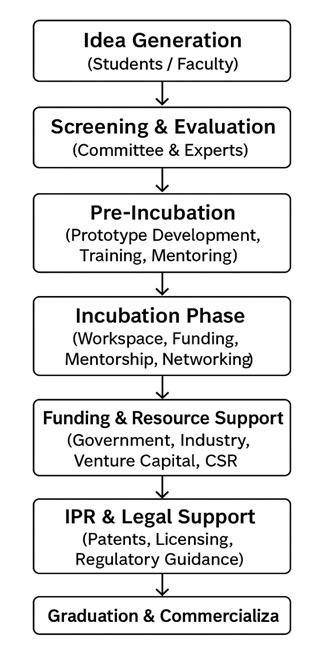
Role and responsibility of committee:
Chairperson (Head of Institution)
- Provide overall vision, leadership, and strategic guidance.
- Approve policies, annual plans, and budget for IIC.
- Ensure alignment with institutional goals and national innovation/startup policies.
- Represent the IIC in external collaborations (MoUs, partnerships).
Coordinator / Convener (Faculty In-Charge)
- Act as the operational head of the IIC.
- Plan and execute innovation & incubation activities.
- Coordinate between students, faculty, mentors, and external stakeholders.
- Maintain records, reports, and communicate with government agencies (AICTE, DST, MSME, etc.).
Faculty Members
- Identify and nurture innovative ideas from their departments.
- Mentor students in technical, managerial, and research aspects.
- Organize workshops, hackathons, and awareness programs.
- Assist in IPR filing and research commercialization.
Industry Experts / Alumni Entrepreneurs
- Provide mentorship in business planning, marketing, and scaling startups.
- Connect startups with industry networks and investors.
- Guide on market trends, product validation, and commercialization strategies.
- Support in MoUs, CSR funding, and consultancy opportunities.
Student Representatives
- Act as a bridge between students and IIC committee.
- Promote participation in hackathons, startup competitions, and innovation events.
- Share innovative ideas and encourage peers to join incubation programs.
- Help in event organization and peer-to-peer learning.
Innovation/Startup Mentors
- Provide specialized mentoring in technology, business models, and fundraising.
- Guide teams in preparing pitch decks, investor presentations, and startup documentation.
- Help in prototype development and scaling to MVP (Minimum Viable Product).
- Monitor progress and report to the committee.
Convener Contact (Details for website)
| Name of Convener- Dr. Anil Kumar, Associate Professor, BBDITM Email : [email protected] Mob. : 9450736616 |
The Alumni Committee of BBDITM facilitates sustained engagement with graduates, promoting mentorship, collaboration, and institutional development. It serves as a bridge connecting past students with the institute’s current academic and placement ecosystem. The committee supports alumni interaction events, maintains alumni databases, and encourages contributions toward academic excellence.
Objective
Following are the objectives of Alumni Committee:
- To keep a roster of all Alumni of BBDITM with their updated and current information.
- The Alumni cell aims to keep the Alumni connected to the College via events, guest lectures, reunions and networking opportunities.
- To promote sense of belongingness among the Alumni by being in regular contact with them.
- To provide a forum for the Alumni for exchange of ideas on academic, cultural and social issues by organizing and coordinating reunion activities.
- To extend the help to the students of BBDITM for placement and industrial training.
- To act as a bridge between college and the industries for interaction on new developments in different disciplines of engineering.
- To assist the college to promote R & D activities, testing and consultancy.
- Provide valuable suggestions through feedback system and taking offline/online lectures on demand.
Functions of the Committee:
- Maintain and update the alumni database regularly.
- Organize alumni meets and mentorship programs annually.
- Facilitate alumni talks, workshops, and expert sessions for students.
- Encourage alumni involvement in placements and internships.
- Collect feedback from alumni to enhance curriculum and employability.
- Coordinate with Alumni Association for collaborative events.
- Promote alumni success stories through digital and print media.
Members Alumni Committee:
| Convener | Members |
|
Dr. Diwakar Yagyasen
|
|
| Frequency of Meeting: | Once every semester and during Alumni Meet events. |
Mechanism of Committee:
The committee functions under the supervision of the Director and works with the Training & Placement Cell to ensure alumni participation in institutional activities. A structured communication flow exists between departments, alumni network, and the central alumni database administrator.
Roles and Responsibilities:
- Strengthen alumni-institute relations through regular communication.
- Encourage alumni mentorship for students’ career development.
- Facilitate alumni contribution to academic and research initiatives.
- Maintain updated alumni profiles and event records for NBA documentation.
- Collaborate with the placement cell for internship and job opportunities.
Convener Contact Details:
| Name: Dr.DiwakarYagyasen, Convener, Alumni Committee, BBDITM Email : [email protected] Mob. : 8127509234 |
About The Committee: BBDITM establishes the student counseling cell to provide counseling for psychological and other related problems of the students. The cell also works to develop self- confidence for preparation of competitive examinations and develop learning skills among the students.
Objectives of Committee:·
- Student Counselling Cell aims to help students become self-aware and reach their highest potential while dealing with anxiety and stress
- To help the students in solving their personal, educational, social as well as psychological problems.
- Provide various comprehensive psychological services to students and resolve their emotional, behavioral, academic, and social issues.
- To create awareness about issues and problems related to mental health of student
- To motivate faculty in counselling activities.
- The office of Counselling led by Student Counsellor provides a confidential atmosphere in which the students can explore any topic or situation and discuss any concerns thy may have.
Committee Members:
| Convener | Members |
| Dr. Pooja Singh | 1. Mr. Achman Mishra 2. Ms. Jyoti Gaur 3. Mr. Ravi Shankar 4. Mr. Fazlur Rahman 5. Mr. KamleshwarDharDwivedi 6. Mr. Abhay Yadav 7. Dr. Shailja Pandey 8. Dr. Pragya Singh (Psychologist Cum Professional Counsellor) |
| Frequency of Meeting | Once in a semester |
Mechanism of committee:
- The students referred to the Students Counseling Cell through the office of Director-BBDITM, Dean Students Welfare and Students grievances cell will be addressed by the committee.
- The Committee members upon interaction with the students to be counseled will take up the task within the committee first.
- If required the professional counselors from amongst the various institutes/colleges in and around the nearby vicinity will be approached for assistance.
- In case medical help required parents/guardians of the students will be approached/ contacted to take care of their ward.
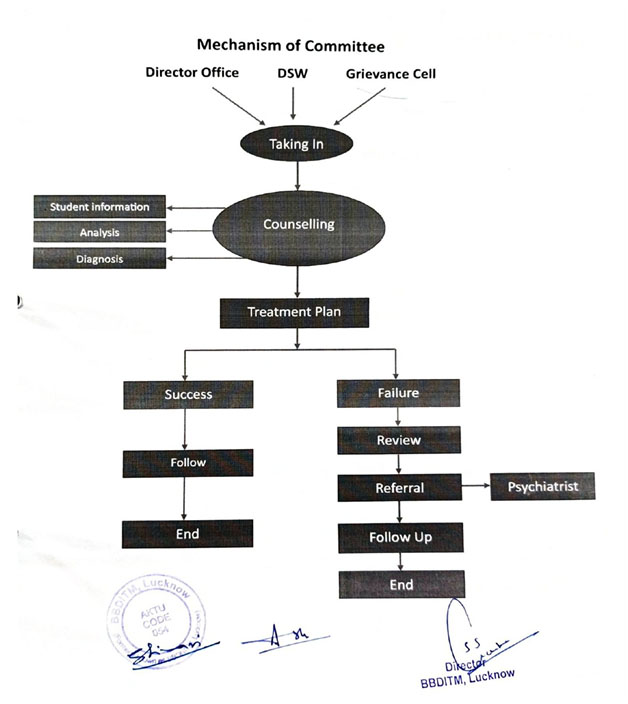
Role and responsibility of committee:
- Solve personal problems of student by conducting individual counselling session
- Boost self-esteem of weaker /physically challenged students
- Diagnose the learning difficulties of students and help them to overcome the same.
- Help the students to overcome examination stress or fear.
- Conduct seminars for students on mental health and addiction issues.
- Refer the students to professional psychiatrics or counsellors in severe cases.
- Inform the parents about psychological misbehavior of the student.
Convener Contact:
| Name of Convener- Dr. Pooja Singh Convener, Student Counseling Cell, BBDITM Email :[email protected] Mob. : 94154346986 |
The Technical Committee of BBDITM Lucknow plays a crucial role in fostering technical excellence and innovation within the institution. Comprising faculty members, industry experts, and student representatives, the committee is responsible for organizing technical events such as workshops, seminars, hackathons, and conferences to enhance students’ practical knowledge and industry readiness. It also oversees the development and maintenance of laboratories, supports technical clubs and societies, and promotes research and development initiatives. Through its efforts, the committee aims to create a dynamic environment that encourages creativity, problem-solving, and hands-on learning among students.
The functions of Technical committee are listed below:
- Organize Technical Events- Plan and conduct workshops, seminars, coding competitions, tech fests, webinars, and hackathons.
- Support Technical Clubs & Societies- Guide and assist departmental clubs in their technical initiatives and activities.
- Promote Research and Innovation- Encourage students and faculty to participate in research, publish papers, and file patents.
- Maintain and Upgrade Labs- Oversee the development, modernization, and smooth functioning of technical laboratories and equipment.
- Bridge Industry-Academia Gap- Facilitate guest lectures, industrial visits, and collaborations with industry experts.
- Enhance Technical Skills- Organize training programs to improve coding, designing, automation, and core engineering skills.
- Coordinate with IQAC & R&D Cells- Align technical activities with institutional quality assurance and research objectives.
- Encourage Student Participation- Involve students in planning and execution of technical programs to build leadership and project management skills.
Committee Members:
Under the Chairmanship of Director of the Institute, the Internal Quality Assurance Committee of BBDITM has been constituted as per the norms of AICTE and guidelines prescribed by NBA, with following members under varying categories.
| Convener | Members |
| Mr. Rafik Ahmad
Convener
| 1. Dr. Abhimanyu Yadav 2. Dr. DiwakarYagyasen 3. Ms. Priyanka Gupta 4. Dr. Anil Kumar 5. Mr. Abhishek Dubey 6. Mr. Abhay Yadav 7. Ayush Patel(Student) 8. Rahul Yadav(Student) 9. PrateekVerma(Student) 10. Tulika Srivastava(Student) 11. SubratDwivedi(Student) 12. Rishit Mishra(Student) 13. SayedaFatma(Student) 14. Shruti Rai(Student) 15. Aryan Sharma(Student) 16. Alexander Das(Student) 17. AkhandPratap Singh(Student) 18. SagarDharDwivedi(Student) 19. Abhijeet Sharma(Student) |
| Frequency of Meeting | Twice in a year |
Technical Committee Mechanism:
Technical committee shall evolve a mechanism and procedure for:
Event Coordination
Upon deciding on technical events (workshops, seminars, competitions), sub‑committees or student volunteers are assigned specific responsibilities for smooth execution.
Resource Allocation
The committee assesses the need for lab equipment, software licenses, or training materials and forwards proposals to the administration for approval and funding.
Collaboration and Communication
Coordination with other institutional bodies such as the Research & Development cell, IQAC, and Training & Placement cell ensures alignment with broader academic goals. Industry partnerships and guest lectures are arranged through formal communication channels.
Monitoring and Feedback
Post-event feedback is collected from participants and stakeholders to evaluate effectiveness and identify improvement areas. Performance metrics may include attendance, participant engagement, and skill enhancement.
Documentation and Reporting
The committee maintains records of all activities, reports to the institute’s governing body, and contributes to annual quality assurance reports.
Roles and Responsibilities:
The roles and responsibilities of the Technical committee are to:
- Planning and Organizing Technical Activities- Design, schedule, and oversee workshops, seminars, technical fests, coding competitions, and other events that enhance technical learning.
- Lab and Equipment Management- Ensure proper maintenance, upgrading, and availability of laboratories, tools, and technical equipment for students and faculty.
- Promoting Research and Innovation- Encourage and support research projects, publications, patents, and innovative technical solutions by students and staff.
- Industry Interaction- Facilitate collaboration with industry experts for guest lectures, internships, industrial visits, and real-world project exposure.
- Skill Development- Organize training sessions, boot camps, and certification courses to improve students’ practical and technical skills.
- Monitoring and Quality Assurance- Regularly assess the effectiveness of technical programs and activities, collecting feedback for continuous improvement.
- Resource Management- Identify and request necessary resources (funding, equipment, software) to support technical initiatives and infrastructure.
- Student Engagement- Involve students actively in committee activities, encouraging leadership and teamwork through participation and event management.
Convener Contact Details-
| Name: Prof. Rafik Ahmad, Convener, Technical committee BBDITM Email : [email protected] Mob. : 9450026899 |


